The email you send the next morning is a confession.
You met someone. You liked them, or you think you did, which is already a softer fact than it was at 10pm. You open a blank message because every piece of networking advice you’ve ever half-read says the follow-up is where the relationship starts. Then you sit there. You have their name. You might have a company. You do not have a sentence that belongs only to them.
So you write the sentence that belongs to everyone. Great to meet you. Really enjoyed the chat. Would love to stay in touch. You hover, you feel slightly dirty, you send it anyway, because sending nothing feels ruder than sending cotton. They can tell. Not because they’re gifted at reading people. Because they got four of those before lunch, and yours is indistinguishable from the one sent by the person who talked to them for ninety seconds by the coats.
A follow-up with no specifics is an announcement that you lost them.
I don’t think this is a writing problem. People who can write a sharp email for work still produce mush the morning after a dinner. The mush is what’s left when the specific thing evaporated overnight. The joke about the badge printer. The fact they’re leaving a job in June. The essay you said you’d send, which you can no longer attach to a face. If any one of those had survived, the email would have written itself in two lines. Great to meet you is what you type when the two lines are gone.
There’s a school of advice that treats this as a discipline issue. Send it before midnight. Use their name. Mention one detail. I’ve tried the before-midnight version on a night when I got back to a hotel that smelled like carpet shampoo, shoes still on, writing from the edge of the bed. The “one detail” I could find was the panel they were on. They already knew which panel they were on. Citing it didn’t prove I’d listened. It proved I had a schedule.
The detail has to be theirs, and it has to be the reason you wanted the next conversation. “You were wearing green” is a surveillance note. “You said the signup asked for a company size before it asked your name, and you wanted that dead” is a reason to write back. One of those can be faked from a photo. The other one only exists if somebody stored it while it was still true.
This is why I’m bored by tools that nag you to follow up. The nag assumes the hard part is remembering to send. The hard part is having anything to say that isn’t a template. A reminder on Thursday with a name and a company is a prompt to go write cotton again. It doesn’t restore the sentence. It just moves the embarrassment to a calendar square.
What should have been stored is small. Who they were. Where you met. Why it was worth writing at all. If the third line is empty, don’t send the email. I know that sounds rude. It’s less rude than a message whose only information is that you have their address. Silence at least doesn’t pretend the night stayed intact.
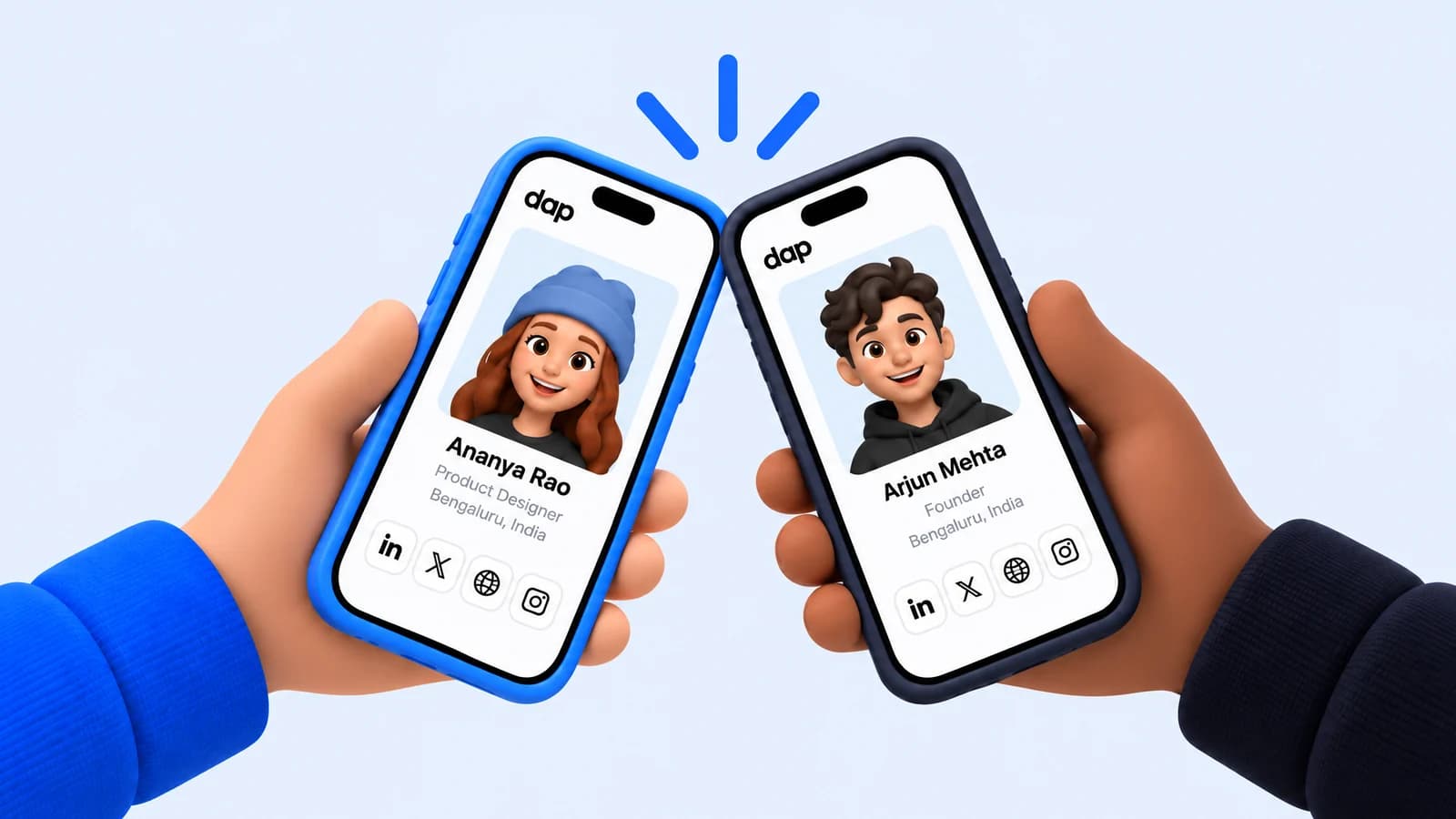
Dap’s bet is that the third line gets kept with the exchange, against the event, instead of being reconstructed from a hotel bed. You can claim the page people would be writing to. The tap that hands it over in the room is the app, and the app isn’t out, so I’m not going to describe a morning-after flow you can run tonight. The failure mode is already available to you. Check your sent folder.
I don’t know if a perfect record would make every follow-up good. Some conversations were polite and thin, and no filing system should promote them into a relationship. Those you can drop. The ones that hurt are the ones that were real for twenty minutes and then got flattened into “great to meet you” because the twenty minutes didn’t land anywhere durable. You didn’t forget to be polite. You forgot the only part they would have recognized as theirs.
Read the draft before you send it. If you could swap in another name from the same night and nothing in the body would break, delete it. That test is humiliating the first time you apply it. It’s also the whole difference between a follow-up and a receipt.
Keep one specific from the night somewhere that isn’t your head. Not a transcript. A line. If the line is missing in the morning, you already know what the email is going to be, and you already know they will feel it.
The people worth writing are the ones who would notice if you didn’t mention the thing you actually talked about. Give yourself a way to still have that thing in the morning. Otherwise the email isn’t a follow-up. It’s you, telling on yourself.