“What’s your Instagram” is what you say when the conversation was good and the exit is awkward.
You trade a handle. Or you both open a code and do the little phone dance in a corridor with bad light. Or someone taps the card stuck to the back of their phone and a contact drops into yours. You walk away feeling like you networked. What you stored is a username. The introduction already happened, out loud, and none of it survived the transfer.
I get why the handle won.
It’s fast, it’s already how you find people, and it doesn’t make you look like you’re selling insurance. A paper card in 2026 can feel like a costume. So you skip it and give them the place you already exist. Instagram, LinkedIn, a personal site, whatever you can say in four syllables while a stranger is trying to leave.
The failure shows up later, and it’s boring, which is why people blame their memory instead of the exchange. You open the app. There’s a new follow, or a connection request, or a contact named saved as @maya.builds. You remember liking them. You do not remember the thing you were going to send, or whether they needed an intro or offered you one. The profile can be full of posts and still empty of the ten minutes you actually spent.
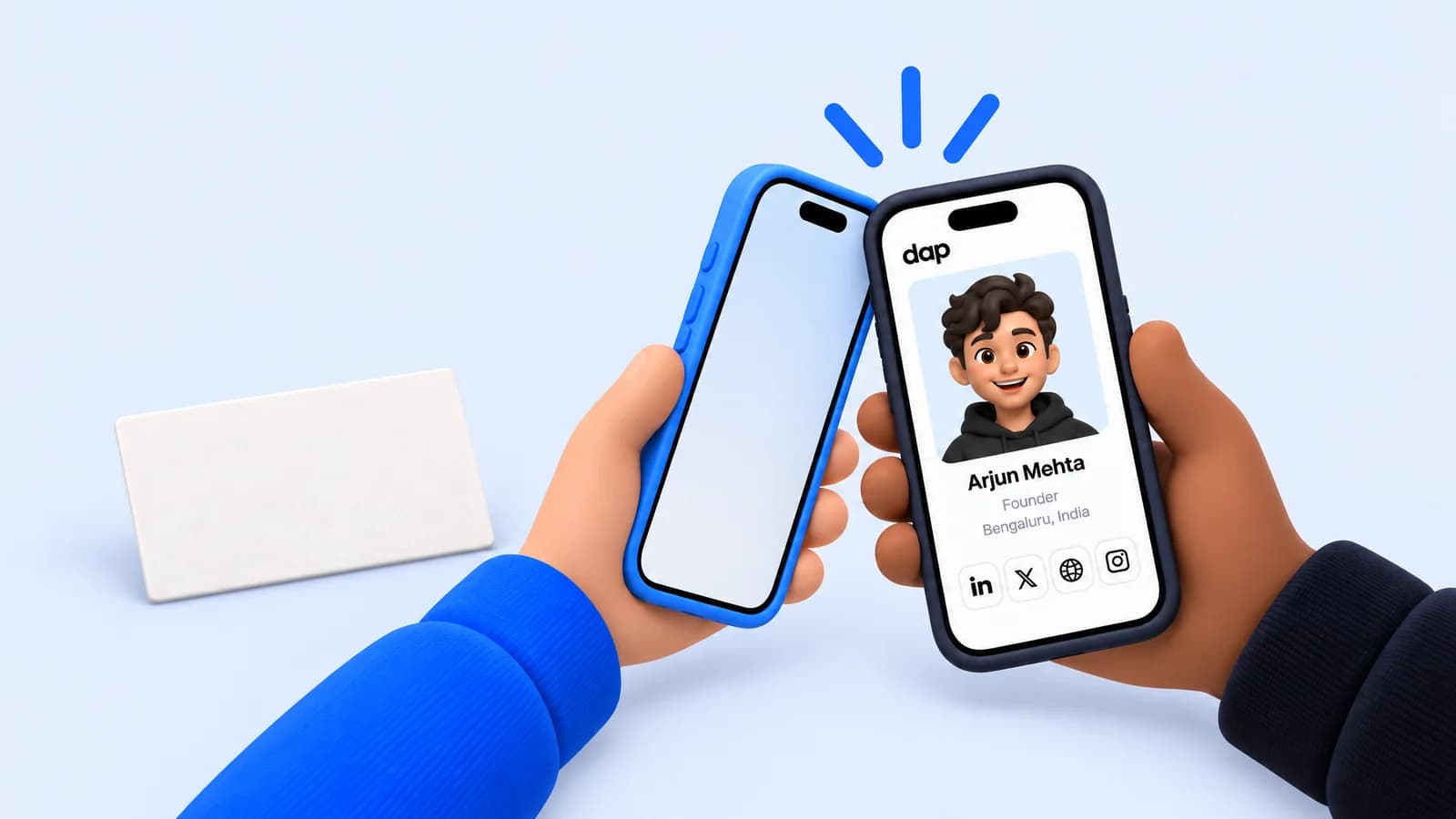
Codes have the same hole. They’re better than dictating an email across a loud room. I’ll give them that. A code can point at a real page, with a name and the links you’d otherwise spell wrong. Dap’s page is that kind of page. You claim an address, put your name and the links on it, and it lives on the web. Useful. Also incomplete, if the only thing that moved between you was the address. The corridor didn’t get saved. The sentence that made you stop, the one you’ll wish you had on Thursday, didn’t get saved either. You have a URL and a feeling, and the feeling expires first.
Digital cards that beam a contact across a tap are the same idea in a nicer material, a cousin that still thinks the card was the point. The radio is newer than the cardboard it replaced, and that’s the entire upgrade. The payload is still a card. Name, title, email, maybe one link. Nobody’s card includes “we argued about onboarding for ten minutes and I want to continue it.” There isn’t a field. So the transfer keeps the part you could have read off a lanyard, and loses the sentence you’ll want on Thursday.
I’m suspicious of any exchange you can finish without either of you having said anything. If the whole gesture works in silence, it probably captured a pointer, not a person. Pointers matter. You need somewhere to find them later in the week. You also need a reason to want to, and the reason was the conversation, which the pointer didn’t hear.
LinkedIn makes the hole obvious because it asks you to say how you know the person and almost nobody does. The request goes out blank. Two weeks later you accept a pile of them on a Sunday and try to rebuild the week from job titles. One of them will be the conversation you actually wanted. You will not be able to pick it out of the pile, because the pile is just places. I’ve done the notebook version of this too. Pages of handles, arrows between them, and still no line that would tell me who to write first.
A booth is a different job, and I don’t want to pretend it isn’t. If you’re standing somewhere on purpose and the exchange is “here is where to find the work,” a code is enough. You weren’t introduced. You were indexed. The trouble starts when a real conversation uses the same gesture as the booth, and you treat them as the same success. One of those you can follow up cold. The other one goes cold because you threw away the only warm part.
A handle is a place. An introduction is a reason to go there. People keep polishing the place, because the place is a thing you can ship as a code or a square in the camera, and the reason is messy and verbal and gone in an hour. I don’t think a sharper code fixes that. A page of your links is still just the place, unless the meeting is attached when you trade it.
Swap the page if you want somewhere honest to send someone. Then insist on keeping why you stopped. Otherwise you’ve done a newer version of handing over a card and putting it in a pocket you won’t check. The pocket got an app. It did not get a memory.