The page you hand someone should be dull.
A name. A line about what you actually do, short enough to say out loud without performing it. The links you want them to have, and not the links you keep out of guilt. That’s the page. It is not a deck. It is not a biography. It is not the pitch you rewrote in the taxi and will rewrite again before the next dinner because the last version suddenly sounded like a stranger wrote it. If the page needs a rehearsal, it’s the wrong object.
I’ve made the other kind. A personal site with a hero line I couldn’t say at a table without wincing, three projects, a photo that was trying too hard, and a contact form nobody used. It looked like a page a person might hand over. In practice I never handed it over. I handed over Instagram, or I spelled an email badly across a loud room, because the site was a brochure and the moment wanted a pointer. Brochures are for when someone asked for the work. A conversation that just got good did not ask for the work. It asked where to find you on Thursday without a scavenger hunt.
Dull is a feature. A pitch is a different meeting.
Watch what people try to stuff into a “digital card.” A headshot, a title, a company, a calendar link, a PDF, a QR code that points at another page that points at the PDF. The card gets heavier every year and no better at the only job it had, which was to be the thing you can exchange without making the other person study you. Studying can happen later, if they want it. The exchange is not the time. You are still standing there. They are still deciding whether you were worth stopping for. A twelve-section site is a strange answer to that decision.
What I want on the page is the stuff I’d be willing to say in one breath. I’m this person. I do this. Here are the places I actually am. If I can’t say the middle sentence without sliding into a pitch, the middle sentence is wrong, not the constraint. The constraint is the room. Rooms do not have time for your positioning.
There’s a temptation to customize it per event. A founder version, a hiring version, a “I’m just here socially” version. I’ve wanted that and I think it’s a trap. The moment you keep variants, you will hand over the wrong one, or you’ll spend the walk in editing the right one, which means you walked in as your own marketing department. One page. If a sentence doesn’t belong in every room you enter, it doesn’t belong on the page. Put it in the conversation, where it can be specific to the person in front of you.
Links are the part people under-think and then over-collect. Every network you’ve ever joined, plus a newsletter with four posts, plus a calendar that implies they should book you. That pile says you don’t know what you want them to do. Pick the few you’d be glad they opened. Drop the rest. A page with two honest links beats a page with twelve logos performing a social life.
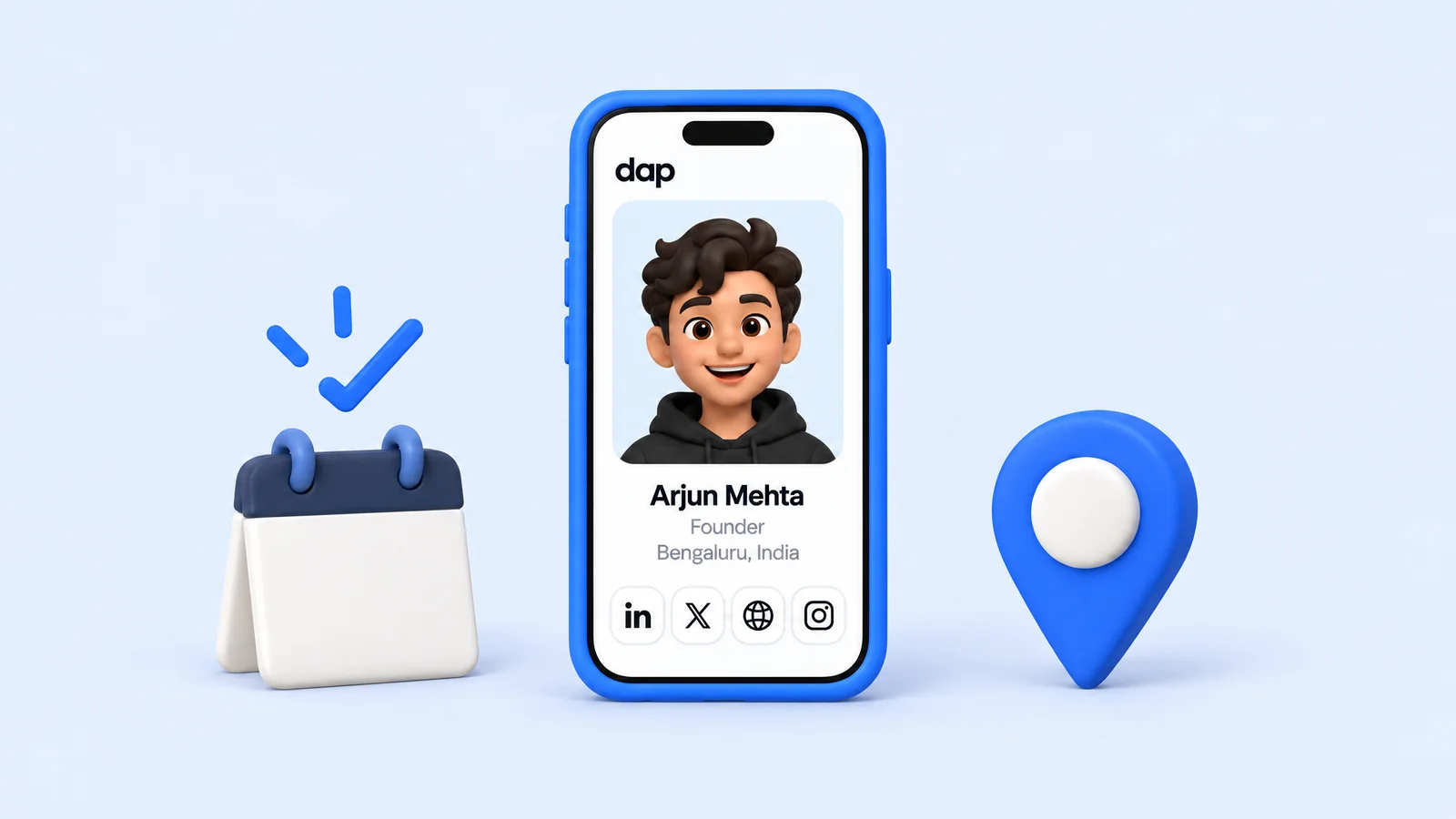
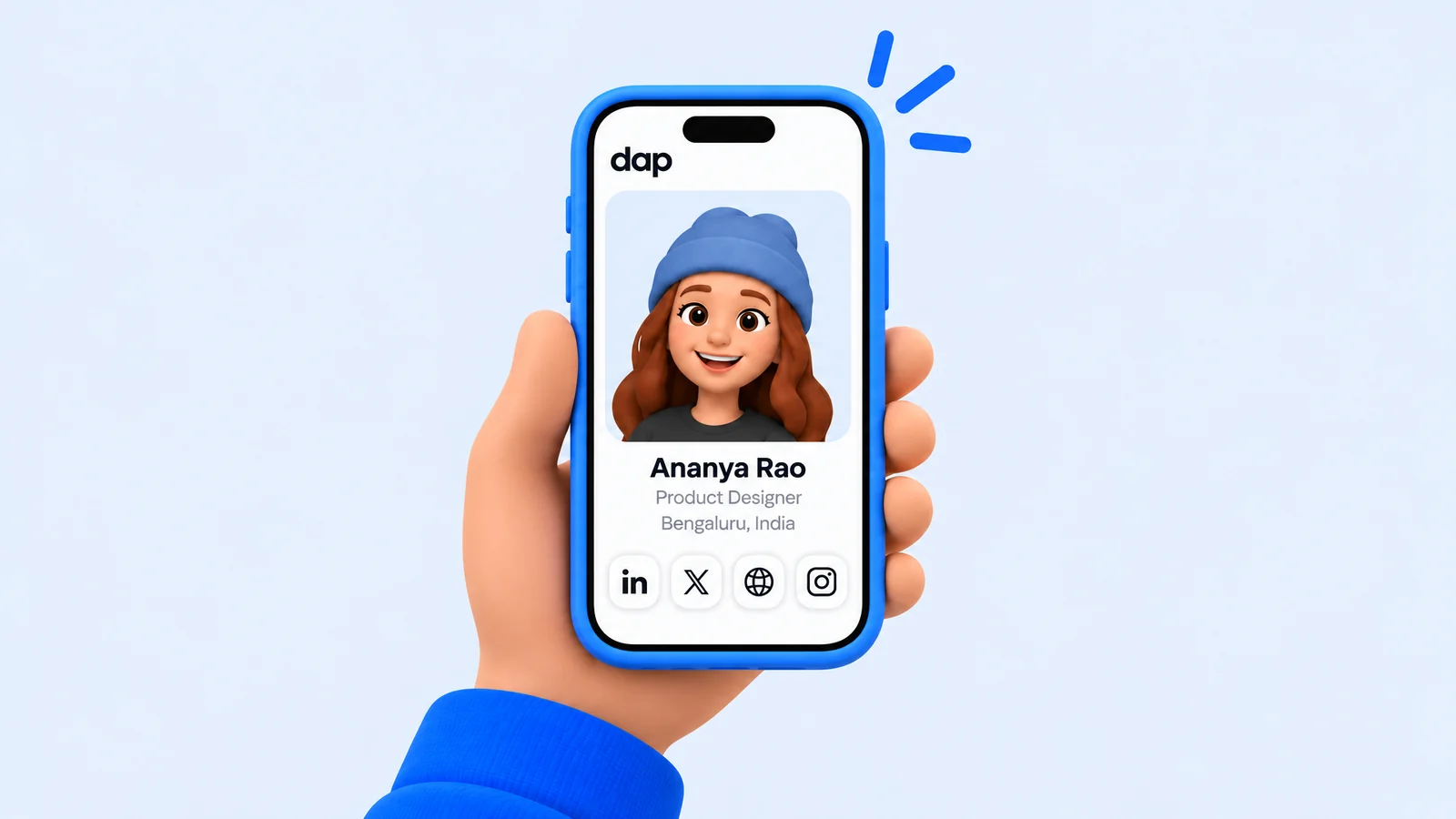
Dap’s page is that dull object. Name, what you do, the links. You claim an address and it’s live on the web, which is the part that exists today. The tap that moves it from your phone to theirs, in the room, ships with the app. The app has not shipped. So the page is not a promise of a gesture you can do tonight. It’s the thing the gesture will carry, and you can make it before the gesture exists. If the page is already a brochure, the tap won’t save it. You’ll just hand someone a brochure faster.
I don’t know where the line is for people whose work is the page. Photographers, writers, anyone who gets hired off the thing itself. They may need one more link than I do, the one that is the work. That still isn’t a deck. It’s a door. If opening it requires a scroll and a manifesto, you built a site and called it an introduction.
If you’re editing the page the afternoon of the event, you’re late, and you’re editing the wrong layer. The page should already be boring and done. The specific thing belongs in your mouth, said to one person, not typeset for a crowd you haven’t met.
Say your name. Say the work in one line you wouldn’t be ashamed to repeat. Put the links you mean. Then stop. The interesting part of you was never going to fit on the page anyway. It was going to happen in the conversation, and the page’s only job is to still be findable after the conversation ends.